


Before we dive in: I share practical insights like this weekly. Join developers and founders getting my newsletter with real solutions to engineering and business challenges.
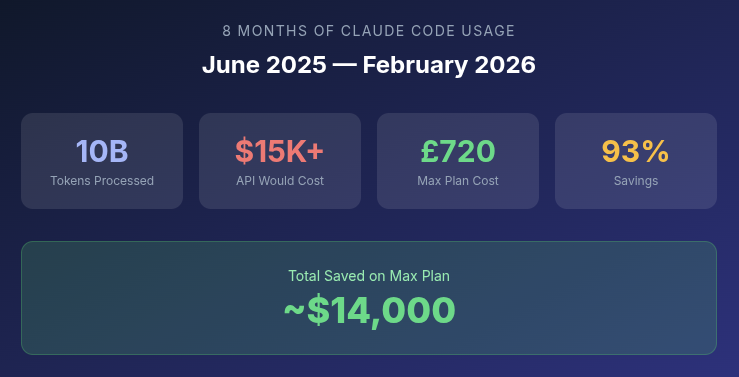
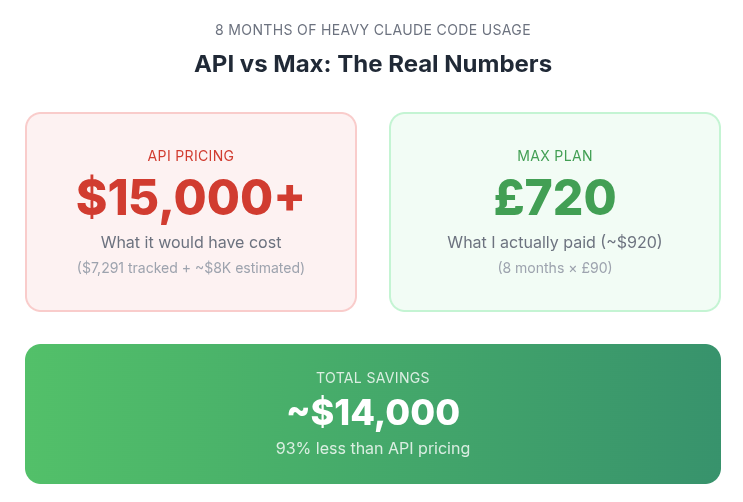
I've been using Claude Code daily for eight months now, across something like 10 billion tokens of usage. I recently dug through my local session logs to estimate what all of that would have cost on API pricing, and the number came to over $15,000. I've been paying roughly $100/month on the Max plan, so around $800 total. That's a 93% saving, and it's not even close to being a marginal decision. I wanted to break down the maths for anyone trying to figure out which Claude Code pricing plan actually makes sense for their usage.
What I Actually Used
Between June 2025 and February 2026 I used Claude Code as my primary development tool across dozens of projects. These ranged from building an SMTP relay for email tracking to working on synthetic genomic data for prenatal testing research, analytics dashboards, profiling tools and various smaller utilities. I was on the Max 20x plan ($200/month) during the heaviest months, then dropped to the 5x ($100/month) when I stopped coding in my day job.
For June through August 2025 I have full token-level data from the local sessions database. The later months are estimated from prompt counts and session logs, which is worth noting because if you're on a subscription plan, the only way to see your actual usage is by digging through the log files in your ~/.claude/ directory. Anthropic doesn't surface this in a dashboard the way the API does.
| Month | Tokens | API Equivalent | Max Cost |
|---|---|---|---|
| June 2025 | 421M | $897 | ~$100 |
| July 2025 | 2.4B | $5,623 | ~$100 |
| August 2025 | 320M | $771 | ~$100 |
| Oct-Dec 2025 | ~5B est | ~$4,600 | ~$300 |
| Jan-Feb 2026 | ~1.5B est | ~$3,000 | ~$200 |
| Total | ~10B | ~$15,000+ | ~$800 |
September had no Claude Code usage, so I've left it out entirely.
The $5,623 Month
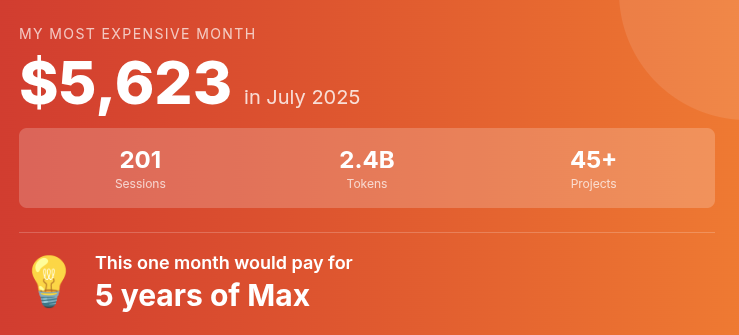
July 2025 was by far the most expensive month. I ran 201 sessions across 45+ different projects, and the API equivalent cost would have been $5,623. That single month is more than five years of the Max 5x plan.
I was deep in building several things simultaneously: an analytics dashboard for tracking AI code metrics, a profiling tool UI, and iterating on the email infrastructure for Cont3xt. I was also doing a lot of exploratory work, having Claude Code help me prototype ideas and tear through codebases to understand architecture decisions. That kind of open-ended exploration is exactly where Claude Code shines, but it burns through tokens at a rate that would be painful on API pricing.
On the busiest single day I tracked, January 22nd 2026, I hit 8,930 messages across 9 sessions with 2,169 tool calls. That kind of intensity is hard to sustain, but it happens when you're deep in a problem and everything is clicking.
Where the Tokens Actually Go
The token breakdown is the part that surprised me most when I first looked at the data. Over 90% of all tokens are cache reads. Input and output tokens, the ones you'd normally think about, are a tiny fraction of the total. Cache writes account for about 6%, and the actual input and output is under 1% combined.
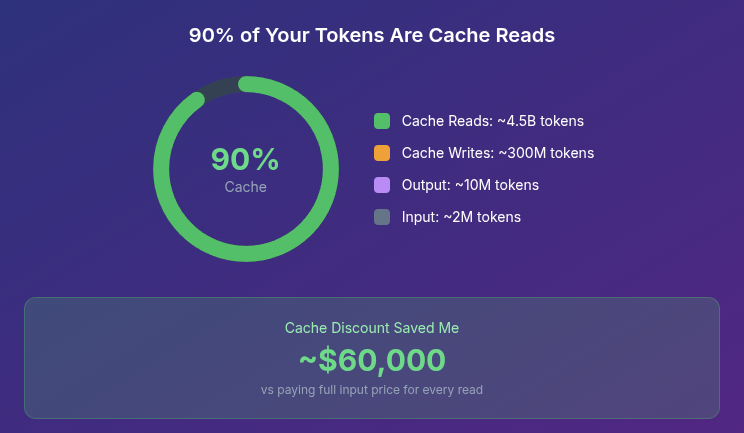
This matters because Claude Code is constantly caching context about your codebase. Every time it reads a file, understands a function, or maintains context about what you're building, that goes through the cache system. If you're working on large projects and switching between files frequently, cache operations dominate your usage completely.
On API pricing, cache reads cost $0.50 per million tokens and cache writes cost $6.25 per million for Opus. These sound small per token, but when you're processing billions of tokens, it adds up. If my 4.5 billion cache reads had been billed as fresh input tokens at the Opus rate of $15 per million, the bill would have been $67,500 instead of $6,750. The caching discount is enormous, but even with it, API pricing is expensive at scale.
The Three Pricing Options
Claude Code has three main paths right now:
API (Pay-as-you-go): Opus costs $5 per million input tokens and $25 per million output tokens. Sonnet is $3/$15, and Haiku is $1/$5. Cache writes are 1.25x the input price, and cache reads are 0.1x. You get full visibility into costs but no ceiling on spend.
Claude Pro ($20/month): Access to Claude Code with 5x the free tier usage. Fine for light work, but sustained development sessions will hit limits quickly.
Claude Max ($100 or $200/month): The 5x tier at $100/month gives you 5x Pro usage, and the 20x at $200/month gives you 20x. Both include Opus access and priority during peak demand.
The Breakeven
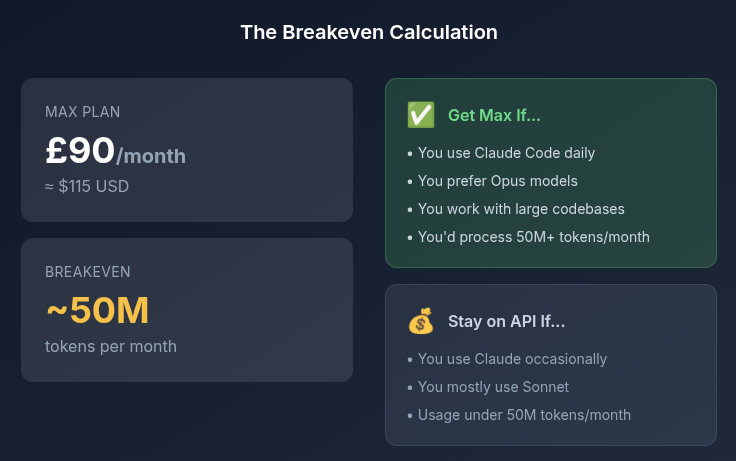
The calculation is simple: if your monthly API equivalent exceeds $100, Max 5x saves you money. If it exceeds $200, the 20x tier makes sense.
From my experience, roughly:
- Light usage (under 50M tokens/month): Under $100 on API. Pro or pay-as-you-go works.
- Medium usage (50-200M tokens/month): $100-400 on API. Max 5x is the sweet spot.
- Heavy usage (200M-1B tokens/month): $400-2,000 on API. Max saves you hundreds.
- Power usage (1B+ tokens/month): $2,000+ on API. Max saves you thousands.
I've found that most developers who use Claude Code as their primary daily tool land somewhere in the medium to heavy range, which is exactly where the Max plan becomes worth it.
Model Choice Matters
My usage was about 95% Opus, which is the most expensive model at $5/$25 per million tokens. If you predominantly use Sonnet at $3/$15, your API costs would be roughly 40% lower. I've been experimenting with different models for different tasks and there's a real argument for using Opus only on complex architectural work while letting Sonnet or Haiku handle routine edits and subagent tasks. On the Max plan this doesn't affect your bill, but it does matter if you're evaluating whether API pricing could work for you.
How to Check Your Own Usage
If you're on the API, Anthropic's dashboard shows costs directly. On a subscription, you need to look at your local files. The session data lives in ~/.claude/ and you can parse the JSONL files to get prompt counts, token usage where available, and session durations. It's not the most user-friendly process, which is why I'm building a cost tracking tool that works across both API and Max plans. Subscribe to the newsletter if you want early access.
My Verdict
For my usage, Max has been the single best value decision I've made on developer tooling this year. The $5,623 I would have spent in July alone covers over four and a half years of the Max 5x plan. Even in lighter months like August, the API equivalent was still nearly 8x what I paid on Max.
If Claude Code is central to how you work and you lean on Opus, get Max. If you're dipping in occasionally or mainly using Sonnet, start with Pro and track your usage for a few weeks. The data doesn't lie, and once you see your own numbers the decision makes itself.